

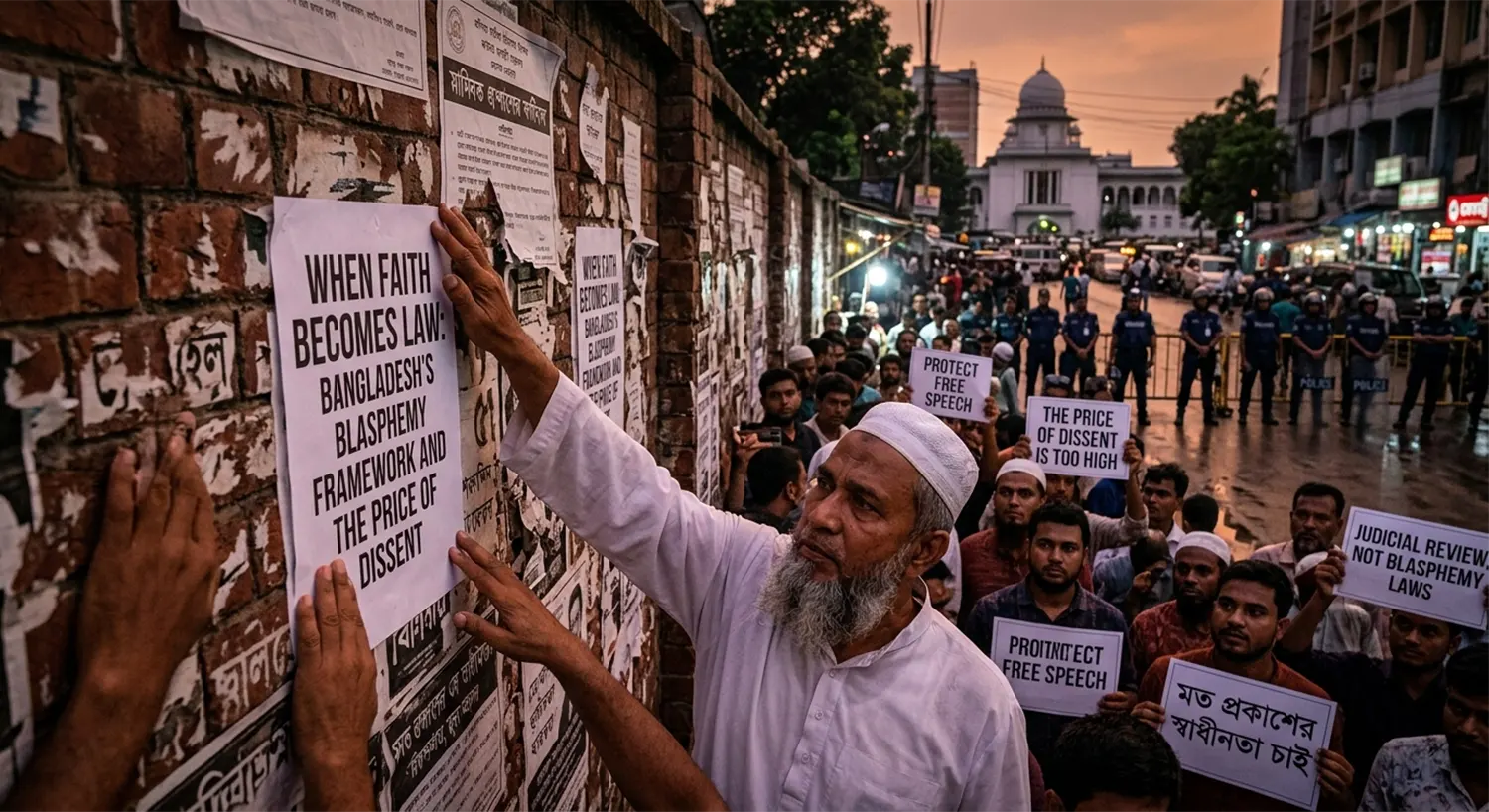
Silenced by Statute, Hunted by Sword
When Faith Becomes Law: Bangladesh’s Blasphemy Framework and the Price of Dissent
Bangladesh was founded in 1971 on four pillars: nationalism, democracy, socialism, and secularism. Half a century later, the country’s relationship with that last principle is arguably its most contested fault line. Secular writers, atheist bloggers, and humanist activists in Bangladesh have faced a two-pronged threat: prosecution under vaguely worded “religious sentiment” laws on one side, and machete attacks by Islamist militants on the other. This article examines how Bangladesh’s legal architecture has created space for both forms of pressure, and how the country’s post-2024 political transition is reshaping — and in some views deepening — that dynamic.
A Constitution in Tension With Itself
Bangladesh’s 1972 constitution enshrined secularism as a foundational value, but that commitment has never been stable. General Ziaur Rahman’s martial-law government struck secularism from the constitution in 1977, and in 1988 Parliament went further, declaring Islam the state religion. A 2010 Supreme Court ruling restored secularism as a constitutional principle, but it now sits awkwardly alongside Islam’s status as the state religion — a hybrid arrangement critics say satisfies no one and leaves the door open to selective enforcement depending on the government in power.
That instability has only deepened since the mass uprising that removed Prime Minister Sheikh Hasina in August 2024. The interim government led by Muhammad Yunus set up a Constitutional Reform Commission, chaired by Ali Riaz, which in January 2025 recommended dropping secularism, along with nationalism and socialism, from the constitution’s core principles entirely — replacing them with a broader “pluralism.” The commission’s head has characterized secularism as a Western import poorly suited to Bangladesh’s context. Supporters frame this as a course correction after years of what they saw as authoritarian rule dressed in secular language; critics, including religious-minority advocates and international monitors, warn it removes a key constitutional check just as attacks on Hindus and other minorities have risen. As of mid-2025 the proposal was still working through a political consensus process, with major parties divided over it.
The Legal Machinery: Blasphemy Without the Name
Bangladesh has no law formally titled a “blasphemy act,” but several statutes function as one in practice:
- Sections 295–298 of the Penal Code (a colonial-era holdover) criminalize acts intended to outrage religious feelings.
- The Information and Communication Technology (ICT) Act’s Section 57, in force from 2013, made it a crime to publish material that could “hurt religious belief,” and was used extensively against bloggers, journalists, and government critics.
- The 2018 Digital Security Act (DSA) replaced Section 57 but kept its substance: content deemed to “offend religious sentiments” could draw up to ten years in prison, and vaguely defined “propaganda” against the state could carry a life sentence. Rights groups and press-freedom organizations widely condemned the law as a tool of repression rather than protection.
- The 2023 Cyber Security Act (CSA), adopted after sustained domestic and international pressure, was billed as a reform of the DSA. Critics argue it retained most of the same vague, religion-related offenses under a new name.
In practice, these laws have most often been used not against violent extremists but against the people extremists threaten — secular bloggers, minority-faith citizens whose social media accounts were hacked and used to post “insulting” content, and government critics whose posts were reframed as religious offenses. Writer Mushtaq Ahmed’s death in custody in 2021, after his arrest under the DSA, became a rallying point for critics of the law.
Violence That the Law Did Not Prevent
Parallel to this legal pressure has been a well-documented campaign of violence against secular and humanist writers, concentrated especially between 2013 and 2016 but continuing since:
- Blogger and Bangladeshi-American writer Avijit Roy was hacked to death in Dhaka in 2015; the group Ansarullah Bangla Team, linked to al-Qaeda in the Indian Subcontinent, claimed responsibility for his killing and those of several other secular bloggers and publishers that year.
- Multiple other bloggers, publishers, and a law student who had advocated removing Islam as the state religion were murdered in machete attacks during this period, several by assailants linked to militant networks.
- A 2016 attack on a café in Dhaka’s Gulshan district, in which militants killed numerous hostages, underscored the broader militant threat, though that attack was not specifically targeted at secular writers.
Some perpetrators have faced prosecution, and a nationwide crackdown after the café attack led to thousands of arrests and a decline in mass-casualty terrorist incidents. But many bloggers who survived attacks or received death threats — including some the state itself later charged under digital-security laws — describe living for years under police protection, in hiding, or in exile, with limited confidence that the state either could or would consistently protect them or prosecute those who threatened them. Some hardline religious leaders and groups have, at various points, publicly called for the punishment or killing of individuals accused of blasphemy without facing legal consequences for those calls, a pattern documented by international human rights and religious-freedom monitors.
Two Threats, One Effect
What makes the Bangladeshi case distinctive in comparative terms is the combination of state and non-state pressure. A blogger deemed to have “hurt religious sentiment” risks arrest and prosecution from the state, and simultaneously risks vigilante violence from militants who view the same content as grounds for extrajudicial punishment. Legal scholars and human rights researchers have argued that vague statutory language — “hurt religious belief,” “cause social unrest” — doesn’t just enable state overreach; it also functions as a kind of informal license, giving militants and mobs a shared vocabulary to justify violence against people the law itself treats as suspect. Minority-community advocates additionally point out that the same laws have been disproportionately used against religious minorities — including through cases where a Hindu individual’s hacked social media account was used to post “blasphemous” content that was then used to justify their prosecution or persecution.
Contested Ground
It would be inaccurate to present this as an uncontested narrative. Several counterpoints are worth noting:
- Government defenders of religious-sentiment laws argue they serve a legitimate purpose in a religiously diverse society prone to communal tension, and that similar “hate speech” or public-order provisions exist in many democracies, including Western ones.
- The scale of violent incidents, while serious, has declined sharply since the 2013–2016 peak, partly due to security crackdowns.
- The current constitutional debate is not monolithic Islamist advocacy — the reform commission’s stated aim is pluralism and de-concentration of power after what it characterizes as authoritarian rule, not an explicit endorsement of religious violence, and its chair has explicitly favored “pluralism” language over discarding minority protections outright.
- Bangladesh’s political mainstream — including the Bangladesh Nationalist Party and the Awami League, bitter rivals on most issues — has historically been divided rather than unified on how far to go in accommodating religious hardliners, suggesting the picture is one of contested politics rather than uniform state complicity.
Conclusion
Bangladesh’s legal framework does not explicitly command violence against secular humanists, but its blasphemy-adjacent statutes — vague, broadly enforced, and historically wielded more often against dissidents and minorities than against those who threaten them — have created an environment where secular and humanist voices face jeopardy from two directions at once: the courtroom and the street. The country’s ongoing constitutional overhaul, still unresolved as of mid-2025, will likely determine whether that dynamic narrows or widens in the years ahead. Whatever the outcome, the record of the past decade — prosecutions under speech laws, killings that went unpunished for years, and public rhetoric that at times normalized violence against “blasphemers” — remains a serious and well-documented concern for human rights observers, even as the political story around it continues to shift.
Related Posts

How Secularism Creates the Intellectual Freedom Necessary for Scientific Innovation and Human Progress Worldwide
Secularism is often misunderstood as merely the separation of religion from the state. In reality,Read More

Humanism in Bangladesh is Growing as More People Embrace Critical Thinking
Humanism in Bangladesh is gaining visibility as a social and intellectual current that emphasizes reason,Read More
Dignity and Humanism: Reclaiming Worth in an Age of Rapid Change and Moral Uncertainty
Dignity and humanism are twin pillars of a humane public life. Where dignity names theRead More
Comments are Closed